The Curlew

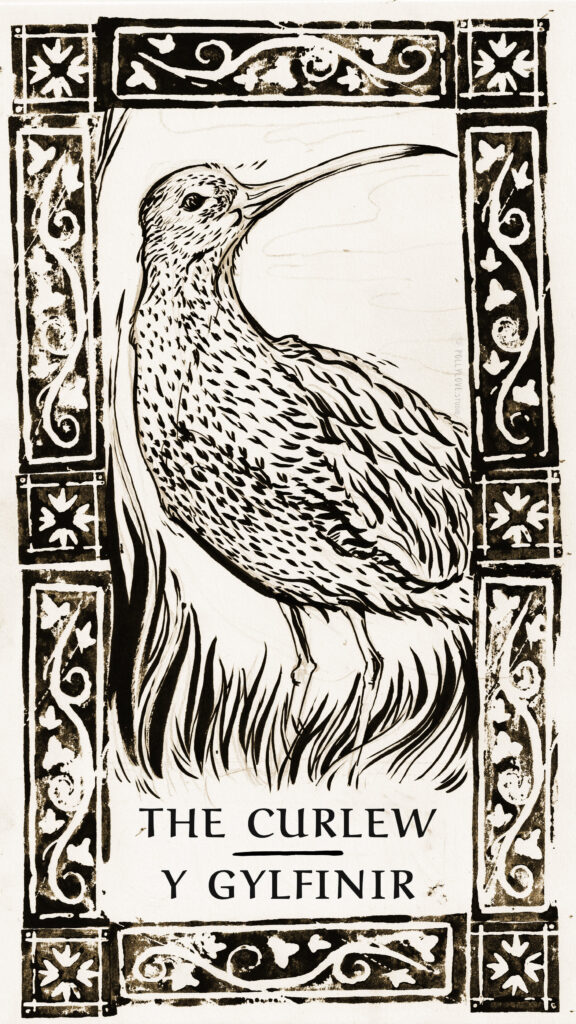
Nothing sounds more like spring and summer than the bubbling call of the curlew – or Pegi Big Hir – Peggy Long Beak – as she’s sometimes known in Welsh. (The Big in the Welsh name is pronounced in the same way as the English word Beak but with a ‘g’ at the end instead of a ‘k’). We are exceptionally lucky in this area to be able to hear the curlew and to offer this iconic bird a home during the summer months. Luckier still as the curlew is, unfortunately, disappearing from many parts of Wales. Iolo Williams describes it:
“A big brown bird, that nests on highlands, moorland and agricultural land and winters on low lying land and the coast. A long-curved beak (the longest belongs to the female), wide long legs. A light brown body darkly speckled. A plain head with much less obvious stripes than those of the whimbrel. When it flies, the wing close to the body is lighter, and there is a white ‘V’ on its back. A big bird, long wings, darker at the tips, they beat slowly. Flocks of them roost in groups or lines that are more numerous than the other waders on the beach. “
The Curlew has many names in Welsh – y Gylfinir, Cornicyll y Waun, Giarliw, Chwibanogl y Mynydd, Cwrlig, Chwibanwr, Cwliwn, Glifinir fawr, Pegi Big Hir, Cwn Ebrill, Gylfinog, Whibanwr, Cyrliw, Glafnir”
The Curlew in Welsh Poetry

We catch a glimpse of the Curlew in the first verse of Waldo Williams’s spiritual Welsh poem ‘Mewn Dau Gae’. Often referred to by his first name only, Waldo was a Christian pacifist, and anti-war campaigner. The first verse of ‘Mewn Dau Gae’ is translated here under the title ‘In Two Fields’. Weun Parc y Blawd and Parc y Blawd are the names of the two fields, and these names are written in Pembrokeshire’s dialect’:
In Two Fields
Waldo Williams
From where did it come, the sea of rolling light
That came to an end on Weun Parc y Blawd and
Parc y Blawd?
After my long inquiry in the darkened land,
From whence did he come, the one who was always there?
Or who, who was the archer, the fleet-footed revealer?
Spirited hunter of field was he who moves the sea.
High above, beyond the bright-piped whistling, above the
Calling of the Curlew,
He delivered unto me the great stillness.

As in the poem, it is only a brief glimpse that we get of the Curlew on the Common too. More often than not, it’s the quintessential song that lets us know of its nearby presence.
The Patron Saint of Curlews

According to an old story, the patron saint of Curlews is St Beuno, and it’s to him that we owe thanks that the curlews’ nests are so difficult to find. St Beuno, who lived in Clydog, used to walk every Sunday to Llanddwyn island, off the coast of Anglesea, to preach. He would walk over the sea to reach the island and walk back over the waves on his way home – just as though he were walking on dry land. But one Sunday, as he returned, he accidentally dropped his important papers into the sea. He was frustrated as he had spent many hours writing his meditations on those papers. To his great surprise however, when he reached land, there on a rock lay his papers. And standing tall beside them, looking after it all, was the Curlew. The bird had saved St Beuno’s work and had carried it to the safety of the rock. In thanks, the saint knelt in front of the bird and uttered a blessing, asking the lord to protect and take care of the Curlew for evermore. Since then, the nests of curlews have always been difficult to find.
Protecting the Curlew

Unfortunately, despite the protection of St Beuno, the number of Curlews has declined over the past thirty years. According to Curlew Wales, today there are as little as 400 breeding pairs throughout all of Wales, whereas in 1993 there were around 5,700 pairs. They say that:
“Amongst factors that affect the curlew populations are birds and mammals stealing eggs and nests, cutting silage too early, walkers with unleashed dogs disturbing the curlew, a lack of permanent pasture, single crops, land drainage (lack of moist pasture for the curlew chicks to rummage through), tree planting. This range of factors reveals the challenges we face in recovering the curlew”
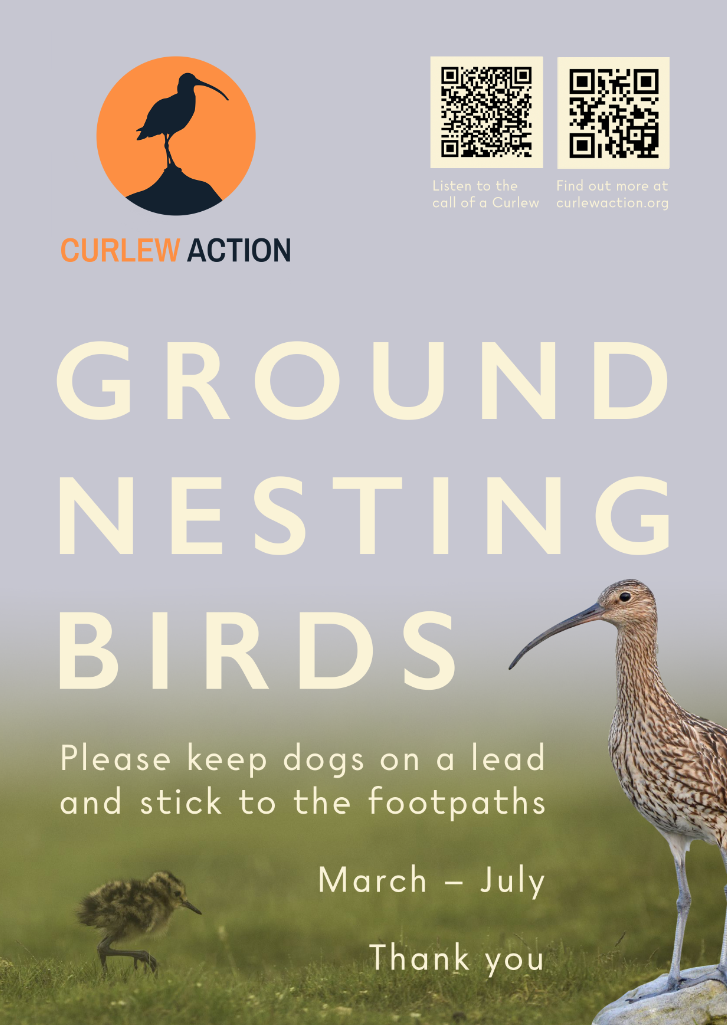
Something that we can do, as people who enjoy the Common, is to make sure that we keep our dogs on leads if we walk across the moorland and be mindful of nests and chicks. You can also volunteer for Curlew Wales’ recovery project. More information can be found on their website curlewwales.org or by contacting hello@curlewwales.org

Stunned by Silence


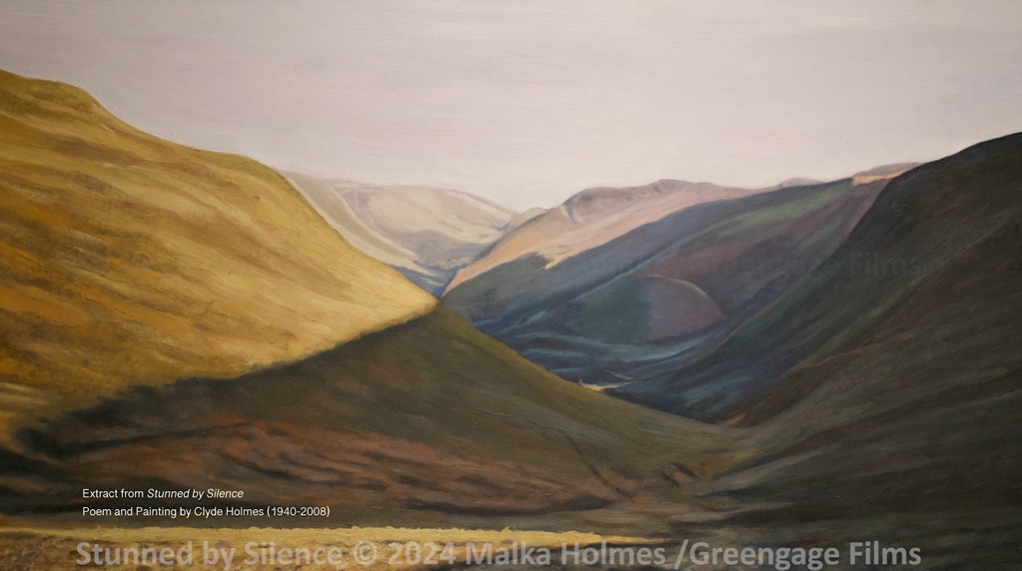


To highlight the hopeful position in which we find ourselves on the Gelligaer and Merthyr Common, we can contrast it to the plight and sadness felt in other areas of Wales where the curlew has already disappeared. Below there is a short 7 minute film by the artist Malka about the personal loss she felt at the disappearance of the Curlew from her north Wales valley. She writes:
“As a child I looked forward to every spring when the Curlew would return from the coast to breed. I used to go out with my binoculars to watch the Curlew on the moor. I often bumped into Iolo Williams up there, he was the RSPB species officer at the time. We now work together on wildlife films.
Sadly about twenty years ago the Curlew disappeared from the valley I grew up in, it never returned to these breeding grounds. Hence the title Stunned by Silence as it’s so quiet up there now without the Curlew’s call.
My father Clyde Holmes, lived in Cwm Hesgin for over forty years. He was an eco-poet and an artist and he painted the ever-changing landscape of the uplands. Out of many encounters with the Curlew his poem Curlew’s nest was born, this poem features in the film.”
The poem by her father along with Malka’s hauntingly beautiful film ‘Stunned by Silence’ – which she has kindly given us permission to share – can both be found below:
Curlews’ Nest
by Clyde Holmes
Must be near the farmhouse
For weeks now
he gasps with wheezy scream.
Above my head, his curved bill
An ominous, sabred silhouette.
Incensed wing-flames
An aerial attack
Sputtering his aggression
In machine-gun rhythms
When I step out
of his circled territory
His sound magically ceases
I am stunned by silence-
freed from his anxiety.
The Curlew Walking Trail

Before long, there will be a new map of a walking route along the Common called the Curlew’s Trail. It is one of the areas where the Curlew can be heard and sometimes seen. If you decide to walk this path, please remember to take great care of this rare, wonderful bird. We’re so lucky to be able to give shelter, still, to old Peggy Long Beak.